About four years ago, I was hitting the gym on my college campus most days of the week, determined to train for Bloomsday, a 12k race in Spokane, Washington. I was first beginning the lengthy process of decreasing and eliminating the massively high doses of medications doctors had prescribed to me under hopefully good intentions but overall poor judgment. The process was arduous at best and came to a screeching halt when my body just couldn't take it anymore--the pain, the increasingly overwhelming fatigue of my still-yet-to-be discovered sleep disorder... I stepped off the treadmill and decided to classify myself into the category of People Who Only Run When They, G-d Forbid, Are Being Chased.
In a sense, I was being chased--by the ticking time bomb that is deteriorating health. Running back then felt very much as though I were trying to escape that pending reality. As much as I felt the aspects of my life that were hard or impossible to control were all external, the environment that was becoming hardest to maintain and exist in was my own physical body--very internal. No matter! Even in my poorest of health and especially as I began to finally, with G-d's help approach wellness, I found other ways to remain active. I found a love and passion for Yoga, for cycling, for swimming and water based activities and eventually, learned to love other forms of cardio, strength and resistance training. Actively and intentionally moving my body helped me regain the strength, balance and function lost in the midst of severe neurological symptoms. Finally, with the help of a trainer and my own focus and determination, I was as much in control of my active movement as I was of my desired stillness.
And then there is the issue of weight--which I have actively avoided discussing on this forum. I was, growing up, always very underweight. I did not even surpass 100lbs until I was nearly a senior in high school. The ill-suited medication regimen I swallowed like a cocktail for over 12 years did quite a number on my body in more ways than one. It didn't matter if I exercised, ate well or entirely the opposite. Despite being told it was not the medications but rather poor choices leading to this weight gain, as soon as I cleaned a few of those culprits out of my system, without actively trying, I dropped 40lbs like a hot potato. It was a lot of weight to lose in a very short amount of time--less than six months. Right around the time I was finally diagnosed with my sleep disorder and began treatment, the pounds started to creep on again. Now I was eating well and working out, but the stress of adrenaline still pumping through my body each night and the lack of restorative sleep took its toll. I decided to continue going to the gym, continue eating well and let go of any further expectations. I worked with the trainer to shift my weight proportions into higher lean muscle mass and lower body fat and did so successfully. Still, by the time I left Washington at the end of July, I'd only actually lost 5 pounds. To my utter astonishment, since moving to New York in mid-August, I've lost over 20 more. This time, however, I sense that my body is finally just letting go and settling into its natural state rather than reacting in shock to being overloaded. (How is that a metaphor for life?!)
And before this past Shabbos, with a new pair of sneakers, I ran my first mile in over four years. I hadn't planned to. I am in Massachusetts visiting family and my father has a small home gym. I'd planned to get in a good long walk and then some Yoga, but a change in Shabbos plans left me with only half an hour to work out. Before I knew what had hit me, I was running--and loving it! And after Shabbos, I hit the treadmill again, this time to run for about two miles. The difference now is like night and day; I am no longer running away from illness, but very much running toward wellness. It is at once exhilarating, exciting and, somehow, calming; healing.
I wish everyone a good week--a week of peace, of wellness and balance. Sometimes we take these things for granted. They come easily, we push the envelope. Sometimes they feel immensely out of reach. We push against that, we draw inward, or give up altogether. They are not far at all; they are states of being that are in fact within and around each of us. And the only difference between a 12k and reaching peace, wellness and balance is that the latter is not a race to the finish; it's all about how you get there. For now, however, I'm going to run, not walk!
Pages
Blah Blah Blahg
A little of this, a little of that, and a whole lot of blah blah blah....
Saturday, November 24, 2012
Monday, November 19, 2012
Upon Arising...
Sleep: it is a topic near and dear to my heart--and for better or for worse, it's often close to my mind as well. It is just a couple of months shy of my Two Year Wellniversary. My battle with sleep apnea is one that for the most part, I've kept somewhat private. I have used this forum as a means to educate, advocate, and at times process, but there is much more that goes on 'behind the scenes' so to speak.
Additionally, it is not a struggle, thank G-d, I've had to fight alone. As much as I have let them, my family, friends, and medical team have not only been behind me in this battle but very much fought alongside me. And on the front-lines, ever ready to guide me, when necessary, to wage war and also, when necessary, to surrender, is the loving hand of G-d Himself.
In a recent conversation with a friend, I shared how the experience of being so sick in and of itself was something that heightened my awareness of how close I truly am (and already was) to G-d. Throughout the worst of the neurological symptoms and in times of great uncertainty - when even the most menial tasks were a challenge, I didn't have the energy for anything other than to want. To want more. To want health. And to want to live. And once all of the extraneous layers of "me" were peeled away, all that was left was the very core essence of who I am: a person of great passion, fervent love and true kindness. What a gift, albeit in unusual wrapping paper, to be able to see that.
And yet, with all my gratitude, all my humility and all of my experience, I had an appointment with my new sleep doctor last week that totally threw me for a loop. I am an expert on my story. Sharing it has earned me opportunities and won me awards. I like to think that, G-d willing, sharing my experience has helped at least one person half as much as experiencing and retelling it has helped me. However, after I finished that part of the appointment, the part I am "good at," the part I am "bad at" happened. The doctor said "sit down, and make yourself comfortable." He opened up my charts and began to read the results of the polysomnogram (sleep study) I had about two years ago. There was nothing inherently bad or good or even indifferent about it--just things I hadn't known, things I had preconceived notions about, things that two years ago would have stopped me in my unbalanced, twitching, pain-riddled tracks.
Thank G-d I didn't know! Thank G-d I had almost two years to get so strong and so healthy that I actually don't have to think about sleep all day and night anymore. Instead of living in irrational fear of what could be lurking behind my sleep apnea, I had the limited information I needed to pursue health and recovery. Now, with the additional information that I have and the information that will come in the following weeks and possibly through a second polysomnogram, I can continue on this truly blessed path toward recovery and wellness.
But alas, I have to be honest. This all looks very graceful and put together in typeface and what really happened is this: I did not receive this news like a mentsch, I received it rather like a silly, stubborn, donkey. I argued with my doctor. I cowered in fear and spent a little time feeling sorry for myself. I had a teeny-tiny-temper-tantrum. And when I was done, and I'd thought and prayed about it, I remembered the first thing I say and truly feel each and every morning upon arising:
Modah* Ani Lifonecha Melech Chai V'kayam Sheh'hechezarta Be Nishmasi B'Chemla Rabah Emunasecha!
*Males would say Modeh rather than Modah
...which means...
"I offer thanks to You, living and eternal King, for You have mercifully restored my soul within me; Your faithfulness is great."
I remembered that first morning after bringing home my C-PAP machine. I woke up after 4 hours of straight, restful, albeit assisted sleep. Tears flowed freely onto my pillow but not because I'd had a sleep riddled with nightmares, night terrors and uncontrollable limb movements . Rather they flowed because every morning up until this one I had only spoken those words by rote. On this morning, for the very first time I had not even opened my lips to speak yet and already I could hear them as if in a dream. It was so beautiful, so melodic, and who knows--maybe I was dreaming. But on that morning, for the first time, I awoke in genuine gratitude. And when I did open my lips to speak those words, for the first time, I said them with kavannah (intent, concentration, focus).
That feeling has without fail returned each and every morning since and again each night as I pray before bed. It was there when I'd been up all night raging against the machine! It was there when mornings still found my body tired, sore and moving uncontrollably. And it is there today, when I awake feeling rested, energized and blissfully still. Furthermore, the only thing that any test result or any diagnostic label can really truly define or measure is just how blessed and lucky I am that each and every morning, G-d has mercifully and faithfully restored my soul within me.
Sunday, November 18, 2012
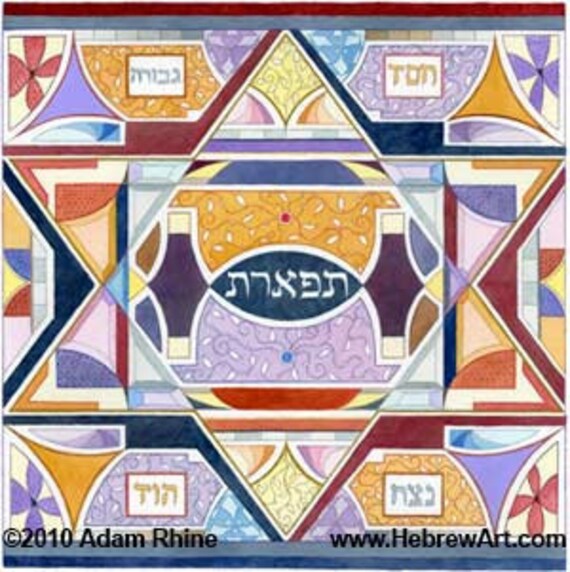
Parsha Post for Veyeitzei: The Supra-rationality of Tiferes
Our reading of parshas Vayeitzei arrives at a meaningful time this year as the dire situation in Israel continues to leave people around the globe in a state of fear and uncertainty. As an American Jew with family, B"H, in Israel, I know the very best thing I can do from here is focus on study, tefillah (prayer), acts of chesed (kindness) and taking on mitzvot. Knowledge, wisdom, faith, kindness and connection are the ideal defense from where I stand, and while I do not intend to use my blog as a political outlet, I will say with confidence and passion--I stand with Israel today and every day.
This week's parsha is the first devoted to the life and times of Jacob. For a synopsis of the Torah portion, click here. You can also read the full text of Parshas Vayeitzei along with Rashi's commentary by clicking here. For the sake, however, of this post, I want to highlight a significant concept that emerges in this parsha that not only corresponds to the month of Kislev and the story of Chanukah, but also is quite meaningful in light of current events.
Prior to this parsha we were introduced to the first two Jewish patriarchs, Abraham and his son, Isaac. Both were extremely righteous men who devoted their lives, efforts and hearts to spreading the word of G-d. Each had his own unique strength and ability in spreading Divinity. Abraham epitomized chesed (loving-kindness) and utilized this character trait to disseminate Divine concepts to as broad an audience as possible. The strength in this approach was that it required no prior preparation from his audience; all his disciples were on a level playing field. A potential flaw was that in not making any prior demands on his audience, his message did not effect permanent change. Isaac personified the idea of gevurah (restraint/judgment) and required his disciples to undergo a process of self-refinement prior to receiving his message. The unique paradox highlighted by both of these methods was well described in last week's Chayenu in the Parsha Toldos Overview, page 7:
"Whereas Abraham's approach can be conceived of as a downward vector, bringing Divinity 'down' to even the lowest rungs of humanity, Isaac's approach can be conceived of as an upward vector, elevating people so they can integrate increasingly higher levels of Divine consciousness into their lives."
Both Abraham and Isaac were effective leaders and educators given their audience and the times in which they lived. Jacob, however, epitomizes the concept of tiferes (reconciliation, harmony), personifying the very best characteristics of both his father's and grandfather's methodology. He managed to blend them in a such a graceful way that he is highlighted in six parshiyos as not only the last of the Jewish patriarchs but also as the first and only patriarch to successfully raise all of his children to be completely committed to G-d's will. Jacob saw that to effect lasting and permanent change, he needed to combine seemingly diametric opposites: chesed and gevurah, loving-kindness and judgment/discernment.
How does this relate to the month of Kislev, the darkest time of the year? How does this relate to the story of Chanukah? And how does this relate to the horrendous events that are now occurring in Israel? Switching venues for a moment, I will take you to a maamar (Chassidic discourse) on Chanukah I've been studying by the Lubavitcher Rebbe, Rabbi Menachem M. Schneerson, called (in English) Victory of Light. In the introduction and overview to his discourse, the Rebbe highlights the initial split between the Jews and the Greeks. He explains that the Greeks had no problem with the Jews studying Torah or doing mitzvot. As logical people, they saw many of these laws and customs as sensible and even meaningful. The split occurred when the Greeks could not accept the Jews' fulfillment of mitzvot which did not make sense or hold pragmatic meaning.
The very unique factor of the Chanukah oil itself is that in a sense it epitomizes a significant characteristic of every Jew. There are parts of our soul that fluidly relate to G-d in an intellectual and logical way. There are parts of our soul, that like oil, do not mix with other fluids; this is the part that commits to G-d on an intuitive way that is beyond the parameters of logic and reason. This aspect of every Jew is above intellect; it is supra-rational. The Rebbe goes on to explain the correlation of why upon destruction of the Holy Temple, the Greeks went after the oil. The Temple was filled with things of seemingly greater value than oil! Why was it, then, so important for them to contaminate our oil?
"Every enemy goes after the life-source of their opponent--the wells, the food stocks. The Greeks went after the oil. For therein resides the secret of the Jew. These battles of old are still being fought today. In every generation there are Hamans and there are Greeks..."
The Rebbe continues on to explain that today, "the Greek of old is not always an outsider; he is often alive and well within our own minds, waging a persistent battle against our Divine sensibilities (page 16)."
Abraham and Isaac-- both men of great magnitude and righteousness--acted out of logic and intellect. Jacob, on the other hand, epitomizes that oil aspect in every Jew; he acted supra-rationally, beyond the scope of calculation. He was thereby able to relate to G-d and to inspire those around him in a whole new way, through the characteristic of tiferes. At our very best, we combine these aspects of chesed and gevurah and personify this idea of harmony. In times of darkness, of violence and war--whether it be overseas, in our own backyard, or, G-d forbid, in our own minds, we cannot see the value in that which is above our comprehension. We cannot understand the light that emanates from acts that are supra-rational and above logic. And yet, there is inherent value in that. There is inherent light that emanates only from the disconnect between our rational and supra-rational selves. That is the light which cannot be extinguished. Even and especially in times of great distress and immense darkness, all the layers of ration, intellect and logic are peeled away. All you are left with is the core essence of your Self. You act and exist in those moments out of the truest most beautiful nature of who you are--a G-dly soul. And that is above reason.
![]() |
| AM YISRAEL CHAI! |
Prior to this parsha we were introduced to the first two Jewish patriarchs, Abraham and his son, Isaac. Both were extremely righteous men who devoted their lives, efforts and hearts to spreading the word of G-d. Each had his own unique strength and ability in spreading Divinity. Abraham epitomized chesed (loving-kindness) and utilized this character trait to disseminate Divine concepts to as broad an audience as possible. The strength in this approach was that it required no prior preparation from his audience; all his disciples were on a level playing field. A potential flaw was that in not making any prior demands on his audience, his message did not effect permanent change. Isaac personified the idea of gevurah (restraint/judgment) and required his disciples to undergo a process of self-refinement prior to receiving his message. The unique paradox highlighted by both of these methods was well described in last week's Chayenu in the Parsha Toldos Overview, page 7:
"Whereas Abraham's approach can be conceived of as a downward vector, bringing Divinity 'down' to even the lowest rungs of humanity, Isaac's approach can be conceived of as an upward vector, elevating people so they can integrate increasingly higher levels of Divine consciousness into their lives."
Both Abraham and Isaac were effective leaders and educators given their audience and the times in which they lived. Jacob, however, epitomizes the concept of tiferes (reconciliation, harmony), personifying the very best characteristics of both his father's and grandfather's methodology. He managed to blend them in a such a graceful way that he is highlighted in six parshiyos as not only the last of the Jewish patriarchs but also as the first and only patriarch to successfully raise all of his children to be completely committed to G-d's will. Jacob saw that to effect lasting and permanent change, he needed to combine seemingly diametric opposites: chesed and gevurah, loving-kindness and judgment/discernment.
How does this relate to the month of Kislev, the darkest time of the year? How does this relate to the story of Chanukah? And how does this relate to the horrendous events that are now occurring in Israel? Switching venues for a moment, I will take you to a maamar (Chassidic discourse) on Chanukah I've been studying by the Lubavitcher Rebbe, Rabbi Menachem M. Schneerson, called (in English) Victory of Light. In the introduction and overview to his discourse, the Rebbe highlights the initial split between the Jews and the Greeks. He explains that the Greeks had no problem with the Jews studying Torah or doing mitzvot. As logical people, they saw many of these laws and customs as sensible and even meaningful. The split occurred when the Greeks could not accept the Jews' fulfillment of mitzvot which did not make sense or hold pragmatic meaning.
The very unique factor of the Chanukah oil itself is that in a sense it epitomizes a significant characteristic of every Jew. There are parts of our soul that fluidly relate to G-d in an intellectual and logical way. There are parts of our soul, that like oil, do not mix with other fluids; this is the part that commits to G-d on an intuitive way that is beyond the parameters of logic and reason. This aspect of every Jew is above intellect; it is supra-rational. The Rebbe goes on to explain the correlation of why upon destruction of the Holy Temple, the Greeks went after the oil. The Temple was filled with things of seemingly greater value than oil! Why was it, then, so important for them to contaminate our oil?
"Every enemy goes after the life-source of their opponent--the wells, the food stocks. The Greeks went after the oil. For therein resides the secret of the Jew. These battles of old are still being fought today. In every generation there are Hamans and there are Greeks..."
The Rebbe continues on to explain that today, "the Greek of old is not always an outsider; he is often alive and well within our own minds, waging a persistent battle against our Divine sensibilities (page 16)."
Abraham and Isaac-- both men of great magnitude and righteousness--acted out of logic and intellect. Jacob, on the other hand, epitomizes that oil aspect in every Jew; he acted supra-rationally, beyond the scope of calculation. He was thereby able to relate to G-d and to inspire those around him in a whole new way, through the characteristic of tiferes. At our very best, we combine these aspects of chesed and gevurah and personify this idea of harmony. In times of darkness, of violence and war--whether it be overseas, in our own backyard, or, G-d forbid, in our own minds, we cannot see the value in that which is above our comprehension. We cannot understand the light that emanates from acts that are supra-rational and above logic. And yet, there is inherent value in that. There is inherent light that emanates only from the disconnect between our rational and supra-rational selves. That is the light which cannot be extinguished. Even and especially in times of great distress and immense darkness, all the layers of ration, intellect and logic are peeled away. All you are left with is the core essence of your Self. You act and exist in those moments out of the truest most beautiful nature of who you are--a G-dly soul. And that is above reason.
Subscribe to:
Posts (Atom)